Internships typically do not become jobs.

Posted: 12th August 2011 by alexgilliom in Random Reflections

Companies like having free labor around and aren’t always going to replace interns with people they have to pay.  At Blackbelt TV we desperately need more assistant editors and editors but the owner doesn’t not want to spend the money right now.  It works out for me as an intern since I get to a lot more than I otherwise would.  I am Mike’s assistant editor.  This is a problem for Mike because the work load as dramatically increased during my time there so he has had to throw more work my way.  So I am basically getting on the job training to be an editor there but I am not holding my breath for a job to happen.  I have noticed that several people have gotten jobs out of their internships but I feel that is far from typical.  Sometimes jobs will appear that need to be filled immediately and sometimes companies will wait for a long time to fill positions despite the need to fill them.  Blackbelt TV only just got a post production supervisor after needing one for a very long time.  Perhaps the money jsut wasn’t there to fill this job.  The point is that this company would much rather have free assistant editors despite having to get them up to speed every 6 weeks or so.  It costs them nothing and I did get lots of experience and contacts out of it.  It is jsut highly unlikely to become a job.  It would be nice since I am trained but I certainly will not be shocked if I am not hired on.

However, Several people who came out here to LA as interns have gotten jobs at the same places as I said.  So it certainly can happen but trying to get a job out of your internship should not be the focus because it is not the norm.  Many interns have come through Blackbelt TV while i’ve been there and none were asked to stay.  I haven’t been asked to stay either and they clearly could use me.  If you come in at the right time and have the skills they need it is a possibility but don’t let your internship not turning into a job discourage you.  Just try to get the best internship you can and see where it take you.


This leads me to new information I learned about assistant editors in the industry.  I have learned that many of them work a night shift to get tasks done for the editors who work during the day.  Mike told me he actually preferred this schedule because he had more free time.  It took less time to get to and from work since he didn’t have to fight rush hour and he could get all his work done since he was one of the few people even there at night.  Editors need assistants partly because they have to work during the day. The owners and producers are constantly stopping my Mike’s desk to give him new direction and other work gets put aside.  Since I am there during the day as well, My duties often change because of this too.  Night shift editing is very common in the industry especially for assistants.  If I were to be his assistant I would like come into work around 6pm which would be easy because all of the traffic would be going the other direction.  I would then get direction from him before he leaves and I would work on a task list until everything was done then I would leave.  So I might even end up working fewer hours and getting more work done.  At least that has been Mike’s experience in post production.    I’ve had many people tell me that editors have better schedules than other departments.  They often come in later.  And generally don’t have to dress nicely.

Advice on finding editing work

Posted: 12th August 2011 by alexgilliom in Notes to Sequence 64

Use the people you work with at the internship as a resource.  I am faced with the prospect of wrapping up my internship next week and I have to face the real world.  The only people I really know in this industry are the people I am currently working with.  So, I made sure to ask advice of Mike, the editor.  He told me that the resume is the more important thing he has.  He has created many reels but isn’t sure that many employers even looked at them.  Nevertheless, a reel is very important too.  But, I was totally unsure how to make a reel for something like editing.  I know how to do one for something like cinematography but editing is harder to show off.  He told me that it should be 3-5 minutes in length, shorter is better.  Use 30 second clips of things I feel I made good editing/ post choices on, using a lower third to explain what I did with the clip. Post this on youtube or vimeo to send out to people.  No one takes tapes or DVDs anymore.    As I get more experience it is also a good idea to have several reels tailored to different types of employers. For example, If I were trying to get on a cooking show I would emphasize experience I have with cooking shows or multi camera work.    Contacts are the most important thing.  He said that all he had to do was tell his boss to hire me as the intern and it was a sure thing. And he did that because I was an SU student. So never discount SU alumni.  Trust and reputation are huge here.  The producer trusted Mike so she hired me almost without question.  She basically just asked Mike if he wanted me there.  Mike also said to me  that as he has been in the industry for 8 years, so he has many contacts and he would be willing to help me get a tape logger or assistant editing job somewhere as a recommendation from him means as much or more than my resume or reel, at least initially. People will assume I have the skills and experience because recommends me.  The bottom line is that an internship is not just about getting on the job experience but about beginning your job search.  A job search in LA is impossible without knowing anyone.  So use things like NACAN to get an internship and some initial contacts and use the internship as another stepping stone towards a job in post production.

Tours: Imaginery travel while in the office

Posted: 11th August 2011 by ronaldseananthonymcleod in Random Reflections

I have worked on many tours for corporate that are coming up. As I sit in the office sometimes and get requests for talent whether they are hip-hop artist or gospel artist, just the thought of some of these venues and markets that concerts will be performed at places I have not been (YET!) I tend to get eager and excited to know wow I put that concert together for fans to enjoy. Currently, I am working on the finishing markets for the Community Empowerment Tour and The Health and Wellness tour and gearing up for the start of the HBCU Tour which will basically go across the country to celebrate the pageantry of College Football at Historical Black Colleges. I often have the imagination while sitting in the office that maybe just maybe I could take part in the “in the field” action, but being that I am a intern Im unable to take part in the action which unfolds in the other markets. I do know for a fact if afforded an employment opportunity I will be able to travel to the different venues to watch the magic unfold. I’ve also been able to pitch different monetary valuable ideas to my superiors for possible sponsorship opportunities some folks feel as though they are great ideas and may want to look them over for selling opportunities. Overall, I have been pleased with the work I have put in so far here at Radio-One. From business marketing plans to sitting in on million dollar meetings with clients planning tours this experience continues to be fantastic!

Conversations with a Pro: Real Life Concerns

Posted: 11th August 2011 by ericlee63 in Random Reflections

The last time I spoke with Jon, like every time I speak with him, his experience shone, highlighting real-life screenwriting concerns that I’ve neglected or to which, until now, I’ve remained oblivious. I still tend to think about writing a TV episode like it’s a short film, and, while that mindset helps in thinking about story and character, it’s not quite an appropriate outlook for the television. There are formatting differences in TV, driven by the way it’s packaged and delivered to consumers, that separate it from film.  These differences inform the way a writer must structure an episode and, ultimately, conceive a plot. To give one example, the last time I talked to Jon, I read him a beat sheet for the pilot episode I’m writing. “Okay,” he said after I made it through a few beats. “Where do the commercials go?  What about the title sequence?”


Though I was used to writing in three acts for features and short films, hour-long TV is different. A teaser and four acts is standard, though five-act and even six-act shows are growing in popularity. (Here acts refer to the spaces between commercials, not designated parts of the story like the traditional three acts.) Keeping, in my case, four-act structure in mind forced me to shuffle my beats a little bit. Jon reminded me that each scene must propel the story into the next, especially the scenes preceding commercials. “You have to give the viewer a reason to come back after the break.” I know, as a TV viewer, I’ve dumped shows that failed to impress me, switching to another channel during commercial. Perhaps I need to tap into that viewing experience to really better understand my writing process.

I think the best way to go about this blog topic is to use an example from my favorite show, ‘Band of Brothers’.

Picture:

Video:

[youtube http://www.youtube.com/watch?v=VcMk85ZsBh0&w=560&h=349]

The picture is good, you can make assumptions about the time and place by its context clues, but when you watch the video, it hits on so many different levels. Photos and videos shouldn’t really be compared, they both need each other.  In order to get to a video’s million words, you have to first count out the photo’s thousand.

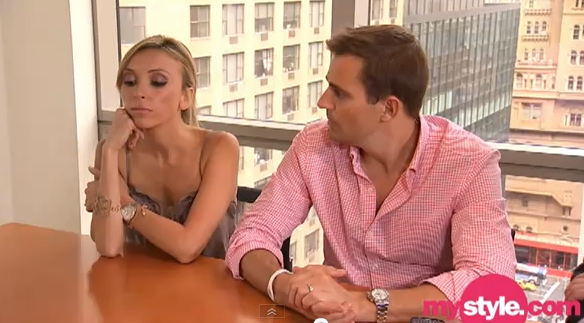
Here’s another example using clips from my favorite show on Style, ‘Giuliana and Bill’.

Picture:

Video:

[youtube http://www.youtube.com/watch?v=xBsC6uNU-IQ&w=560&h=349]

In the picture, one would draw the conclusion that Giuliana is in a bad situation, but when you watch the video, it couldn’t be farther from the truth. Hope you guys enjoyed my little experiment!

Casting YOU.

Posted: 11th August 2011 by kateaquillano in Random Reflections

One of my summer internships is with the Style Network in the Talent & Casting department. I have really enjoyed being exposed to the whole casting process, since I was unable to take a class on the subject. My main duties are to compile a daily trade and blog report, research hot trends in talent, support the development department and aid in casting sessions.

The internship has been great and has flown by (I only have 5 days left)! But, during my time at Style, I have learned one very special lesson: Anyone can make it! With today’s technology, the world is at out fingertips, we just need to jump on it and take advantage of the resources. When a certain trend is hot, we basically scour the internet looking for popular websites, blogs or twitter accounts.  If the individual has built up a strong on-line presence, the talent & casting team will bring them in for a sit down meeting.

If you make a good impression, the talent is put in our database, which we then pull from when producers need names. Last week we sat down with a young woman who had just started her blog back in December.  Eight months down the road, she is already meeting with television networks.

I have a blog (cookingupstyle.com) about cooking and fashion that I mostly do for fun, but after this internship, I am going to start taking it more seriously. Bottom line, if you want something, make it happen!

Different Paths

Posted: 10th August 2011 by ericlee63 in Notes to Sequence 64

Sequence 64ers, there are a number of ways to break into the business, and today we have some options available to us that previous generations didn’t. When considering which path (or combination of paths) to take, it’s of course important to assess your goals (becoming a writer, becoming a director, working at a talent agency, etc.) and pick a route that best suites your ultimate aspirations. Depending on what you want to do, this may limit your range of paths from which to choose, but here I’m speaking primarily to writers and directors who have the full range open to them. As far as an endorsement of a single path goes, I’m not far enough down any road to judge yet. What I can tell you is that I’m trying a variety of paths simultaneously—networking, spec scripts, film contests, webisodes—and I can tell you why.

Networking (via email and phone calls), writing spec scripts, participating in film contests and making a web series are all activities that can be done from virtually anywhere. You don’t have to pick up and move to LA, which is convenient for those of us with family, friends and significant others on the East Coast.  However, for writers like myself, LA holds a vast wealth of opportunities, so I’m certainly not ruling it out and may move there in time for hiring season next spring. Also as a writer, I’m trying not to focus my energy solely on writing; I’m making sure to get involved in some production, attempting to get what I’ve written produced, if only by friends on a small budget. This will hopefully give me something to “show” when it’s not appropriate to hand someone a lengthy script. As Rod Lurie (director of The Contender and Resurrecting the Champ) told us on his visit to Syracuse this past year, speaking of unsolicited material, “No one will read your script.” He repeated it three times for emphasis. “But they will watch your DVD.” He championed making short films to gain attention. Similarly a web series, as good friend John Morgera (Pure Genius Pictures) and I plan to make, may serve as valuable exposure, sort of like our generation’s TV update of a film at a festival. And web series can be easily viewed from anywhere, which is a plus. Yet one of my main reasons for trying diverse avenues is not that it yields the highest probability of success, but that it’s fun. Instead of only getting coffee, I get to have some pull on set, see my scripts come to life, and get coffee. This may not be as financially rewarding as other options, but it’s more artistically fulfilling. And hopefully it’s good practice for one day living out the dream on a Hollywood set.

I started to post this as a comment on my friend Eric Lee’s post called “Keep Writing.”  I could not have said it better than that. You hear it again and again: you have to write everyday.  You have to make time and force yourself to do it.  The reason being, the only requirement to be a writer is to write.  Lawyers litigate, police officers patrol, politicians raise the roof (which is apparently the same thing as the debt ceiling.  Every time I heard this story, I couldn’t help but picture a chamber full of old men and women doing that palms up arm pump motion)…writers have to actually write, everyday.  At least a little.

Now to the point of my post.  While you’re writing and trying to get internships on shows that may one day lead to a paying job, your friends will be leaving their apartments everyday and going to actual buildings with people in them where important decisions are made about what makes it onto your television set. (Run on sentence, I know)  They will get jobs and start making money.  Meanwhile, you may be looking for jobs waiting tables or doing anything not related to the industry that will leave you with enough free time and flexibility to write and work at one of these aforementioned internships on a show.

It’s going to feel like you aren’t getting anything accomplished at times.  You’re going to keep writing knowing that it isn’t going to put food on your table or pay your rent.  You’re going to do twice the work of most of your friends for a long time. (Write full time and work to pay your bills)  It’s going to be discouraging.  What’s going to keep you going?  For me it’s knowing that one day when I finally break in, while my friends all have to dress up and work in the heat on sets, or wear suits and have migraines from that loss of oxygen…I’m going to have a job that I can do in the air conditioner, sitting in my underwear.

Difference in Corporate Filming

Posted: 10th August 2011 by jmorgera26 in Random Reflections

Working on corporate videos is a much different animal than working on entertainment.  That seems obvious, but I have been surprised at how different an animal it is.

My company’s largest client is a pharmaceutical company called Pfizer, best know as the manufacturer for Viagra.  Allied Pixel does a lot of different projects for this company, but once a financial quarter, they do a talking head piece for their salespeople to explain new sales information about their different products.

This is the shoot I was on for my first shoot.  Pfizer, with a large complex in Collegeville, PA, has a studio decked out with a huge, curved green screen wall.  We set up lights and flags to get the green screen exposure just right.  My primary job is as a stand in.  I joke that I was Seth Rogen’s stand in, but then he decided not to be fat.

The day (actually, multiple days, because we left the set up and used it for four days over two weeks) is a parade of executives in charge of a rheumatoid arthritis drug called EMBREL.  We film them in front of a green screen as they read the information off a teleprompter.

The script is written by an outside advertising company from New York, and they bring in their own director, who I believe is freelance, because he doesn’t seem like part of the close knit group of ad execs watching the filming.  Allied Pixel is only providing the crew.

It’s interesting to see the difference in directing this sort of project compared to directing fiction pieces.  While it’s still about the talent’s performance, it’s more about just trying to get regular people to not sound like regular people not used to being in front of a camera.  It’s also interesting to see the ad executives acting as producers, worried about whether the phrasing perfectly reflects the message they want to send about their project.  I guess there is an art to filming non-art.

Learning the Allied Pixel Teleprompter

Posted: 10th August 2011 by jmorgera26 in Random Reflections

My bosses at Allied Pixel are encouraging me to learn their teleprompter system, because think that I can fill in for them as a freelancer after my internship.  While teleprompter operator isn’t my dream job, right now having income is my dream.

On a lot of their shoots, teleprompting is an important part of the work.  They aren’t dealing with professional actors, they are dealing with working professionals who don’t have the time or talent to memorize their lines.

I’ve spent many days taking their tripods and cameras and teleprompters and putting them together.  My supervisor Jay, who is the company’s main teleprompter operator, stressed the importance of being able to set the propter up quickly, because the cinematographer and director are going to be waiting on you to have it set up.  Until the camera is connected to the teleprompter, they can’t look through it and start figuring out their shots and the lighting of the scene.

What I’m finding is the most important thing is to get the weight correct.  There is a long metal plate that the camera and the teleprompter connect to, that is screwed onto the tripod’s mounting plate. The teleprompter screen and reflecting glass weigh a lot, and along with the camera, most of the weight is in the front, leaving the risk of the teleprompter and camera quickly dropping if the cinematographer goes to change the shot.

As far as actually running the computer software, I’m a little nervous about doing it.  I haven’t had any experience with a live person reading off of it.  The best I’ve done is listen to famous speeches, like Martin Luther King Jr.’s “I have a dream” speech and teleprompting that.  Hopefully, that adequately prepares me.