Fast Times at Newhouse #2

Posted: 15th August 2011 by jeremyta in Notes to Sequence 64

Start “networking” sooner than later. 


I really hate that word.  If you don’t hate it…you will.  Honestly, no matter how many CDC seminars you go to, you will probably not master the art of networking as a student.  I’m not sure if it’s something that can be mastered.  But that shouldn’t stop you from trying.  Don’t know where to start? Try your professors.  Find a mentor.  These professors may seem extremely busy and it may take them a while to remember your name, but it’s your responsibility to get to know them and to let them know you.  Once they are invested in you, they’ll do anything to help you succeed.


Don’t forget about the alumni database.  It’s filled with contacts all around the world.  It may seem intimidating but these people wouldn’t give out their info if they didn’t want to be contacted. Just be sure to ask a professor about the contact before you reach out to them.  They may have some inside info for you.


Trust the knowledge of your professors but don’t be afraid to follow your own judgment.  


The faculty at Newhouse is top-notch.  You will figure that out eventually.  They have heard every type of idea and every kind of problem.  They know how to help you and will not hesitate to do so.  Just don’t let your ambition be curved by their criticism.  Sometimes they may caution you against wasting our time.  Sometimes their opinions don’t line up with your own.  Trust their perspective.  Respect it.  But don’t be afraid to take a risk.  Sometimes you just can’t explain your vision well enough.  You have to show them.

Fast Times at Newhouse #1

Posted: 15th August 2011 by jeremyta in Notes to Sequence 64

Try to work with everyone at least once. 


It may seem like an impossible task, but everyone has a unique perspective.  It would be beneficial for you to learn from each person that enters this program with you.  Some people you will love to work with, some you will probably try to steer clear of next time, but with every partnership you get closer to figuring out exactly what you want to do.


Work on at least one additional project outside of class each semester. 


Once again….impossible task, right? Wrong.  Is the workload crazy? Yes. Are you sleep-deprived? Should be.  Should that stop you? No.  The projects you work on in class aren’t just for a grade.  They are to help you build your portfolio.  You want to have something in that portfolio that you created, all on your own, without the constraints an assignment sheet.

Hey Sequence 64ers!

My name is Jeremy Anderson and I’m an aspiring multi-cam director from Sequence 63.  I have advice to offer but I won’t get to that in this post.  Just wanted to introduce myself and let you know my take on the past year at Newhouse.

I’m originally from Jackson, Mississippi.  Far from the grueling winter that you are soon to endure.  Got my bachelor’s in TRF at U of Southern Miss.  Worked at a local news station and a PBS affiliate for a little while.  Then I decided that I wanted to expand my reach in this industry.  Thats where Newhouse came in.  I am currently in NYC finishing up an internship with Space Station Media as a Production Assistant.

After I was accepted to Newhouse I was offered an I.A. position for COM 117.  I quickly learned that I would have to teach 2 labs a week O_o.   I’d never taught a class or even wanted to.  It was fun though.  It took up a lot of my time.  Especially when you are taking multiple production and editing classes as well as directing a show for OTN.  Most of my classmates thought I was crazy and that I was trying to do too much…and I probably was.  But I got through it and I’m glad I did.  I felt like I was taking advantage of everything this program had to offer.  It feels great when you surprise yourself with what you are capable of.  That’s really the only advice I can give you (though I will try to give more).

None of Sequence 63ers have it all figured out.  We were just where you were a year ago and we are only beginning our journey.  Our only hope is that you learn from the mistakes that we made and take full advantage of the year of opportunities that you have been blessed with.

So, have fun this year and if you need any help or advice or even someone to listen to your problems…don’t call me! lol No j/k we all want to be there for you guys.  In all honesty we are probably jealous that you guys get to have so much fun.  But anyway, don’t be afraid contact anyone of us.

Good luck,

Jeremy

Conversations with a Pro: Silly Little Questions

Posted: 15th August 2011 by ericlee63 in Random Reflections

Jon reserved a space at the end of our session yesterday for me to ask him any questions—not questions necessarily related to the pilot I’m writing but questions about anything. I had been keeping a list in my notebook for just such an occasion. All of a sudden the questions I’d recorded seemed very menial and silly. I had questions like, “What do you wear to an interview for a writing job?” “How old are the people in your writing room?” “What screenwriting software do you use?” I warned Jon that my questions were stupid, but he assured me that there are no stupid questions. And though my questions might not have impressed Jon, now I’m happy that I have the answers. (Casual dress; a range of ages, the youngest starting at 30; Finaldraft.)

Though a seemingly minor worry, asking what to wear yielded perhaps the most important response. This question arose because I’d heard two different opinions. One, which I was more inclined to trust, came from one of my SU professors, who worked as a comedy writer in Hollywood for a number of years. He told us that, if you do get a pitch meeting, to look like a comedy writer. Don’t wear a suit and come across as uptight. Dress casually, but look like a million bucks. The other opinion held that you should err on the side of overdressing for interviews. Wear a suit.

Jon settled it for me. “If you wear a suit to a writing interview, people will think you’re crazy. You’ll look like you don’t belong there.” Catastrophe averted. It might have sounded like a silly question, but the little things do matter. Should I get an interview or pitch meeting, I will not wear a suit.


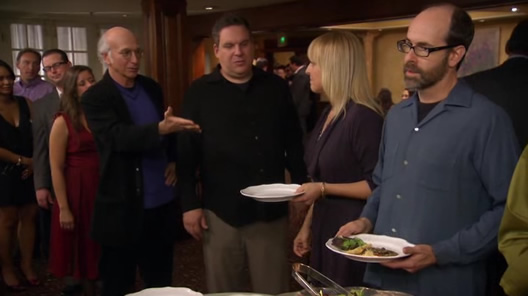
I think most of us would agree that while a picture may be worth a thousand words, a video has the potential to provide us with even greater information. As the blog prompt says, a video is worth a million [words]. In order to illustrate this idea, I have provided both a photo and a video from one of my favorite shows, HBO’s “Curb Your Enthusiasm.”

[youtube http://www.youtube.com/watch?v=nXz-fOtKBU8&w=560&h=349]

In the video above, it is very clear that Larry and the woman who cut in front of him at the buffet line are having an altercation. We witness Larry assess the situation and confront her. Most importantly, we get a clear, keen sense of who this character is: Larry David is a man who views social situations from a very unique (and amusing) perspective. Every day, he observes social norms and delivers his critique on these conventions. Every time he makes his social commentary, he manages to piss people off. It’s part of his charm, and it’s certainly the appeal of the show. This short video gives us a brief but significant glimpse into the character.

Conversely, the photo above (which is a still shot taken from this scene) does not provide us with nearly as much clear information as the video. While an observer might be able to deduce that some tension exists – perhaps due to body language and facial expressions – the photo does not provide us with a model of this character and his behavior. The video gives us a greater understanding of the Larry David character.

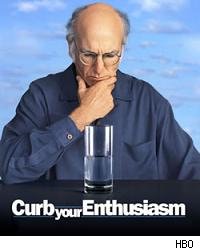
While I believe that it’s generally true that a video is worth a million words as compared to a picture’s thousand, I also feel that there are certain situations in which a still photo communicates the information more effectively and efficiently than a video. The complex character of Larry David can somehow be easily summed up by the ingenious picture below (which also serves as the DVD cover for the show’s 3rd season). Of course Larry is baffled by the half-empty (or half-full?) glass of water. For him, it’s all a matter of perspective. While it’s true that watching an entire episode or season of “Curb Your Enthusiasm” will undoubtedly unlock the many intricacies of Larry David’s persona, his wonderful complexity – his neuroses, skepticism, tendency to overanalyze, and unique ability to view the world from a different point of reference – are all masterfully implied in this one brilliant photo. So while watching episodes of the show will provide greater detail and context as to who Larry David is, this clever photo suggests all of these things in one fell swoop. The photo, then, is a quicker, simpler indication of who Larry David is.

I can’t help but share more “LD” with the world. So here’s one more clip of my favorite neurotic. Enjoy!

[youtube http://www.youtube.com/watch?v=5f2LJXz-l2k&w=425&h=349]


I learned another lesson today after talking with Jon. We were going over an outline I wrote for the pilot episode I’m working on. In the outline, I’d set up a couple storylines in the first two acts. We got through them and everything was fine, but then we came to the third act. “You just built up a bunch of momentum. Here it comes to a screeching halt,” Jon observed. While writing, I had it in my head that Act Three was going to be devoted to a particular plotline. I never stopped to ask myself if that was the most interesting of the plotlines I had. It wasn’t. Looking back on my outline and hearing Jon talk about it, it was clear that I’d chosen the wrong A-story. It should have been obvious sooner. When I struggled to expand it, when I struggled to make myself care about that storyline, I should have realized that there was a reason it appeared to be tapped out so early. That story could only give me so much. The other story, which I established and then moved away from, was the more engaging of the two. I’d developed it to the point that it could have an audience wanting to know what happened next. It could bring people back after the commercials. But, because I failed to stick with what grabbed their attention, when they returned from the break, they would be let down. Why are we going this direction now? What happened to the pressing, high-stakes action? Needless to say, I’m now rewriting my third act, and my third will inform my fourth. This time, I’m sticking to the right story.

Orbiting LaPlanet: Phase 3

Posted: 15th August 2011 by bruizerbutler in Random Reflections

On Set with Asylum Entertainment-

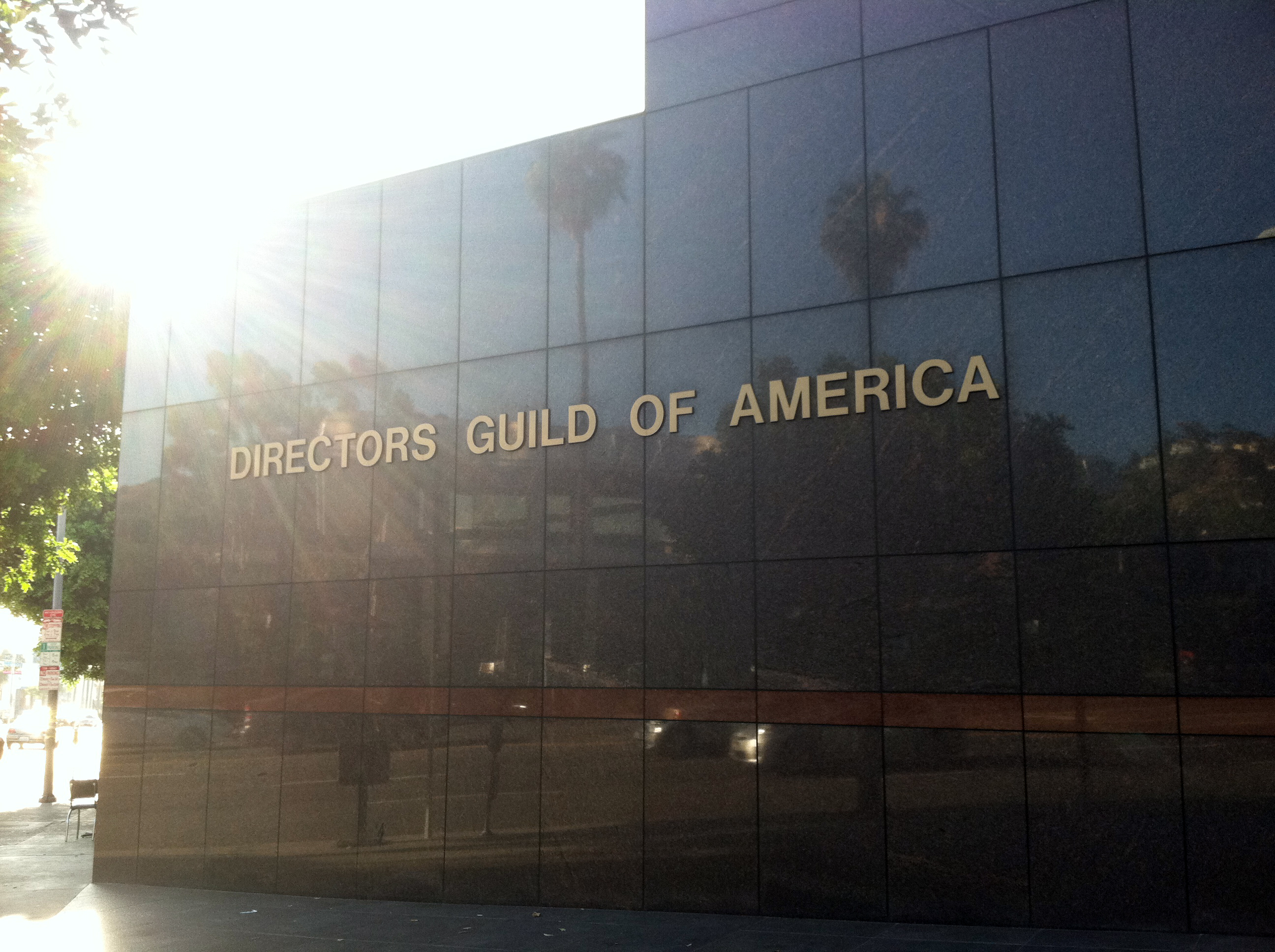
Though the agreed upon internship time had ended, it seemed that both Rob and I were interested in working together longer. I had always offered to do anything I could to help, which I’d inherently learn from, in trying to be the best intern I could be. After Rob and I had our pow-wow on a Thursday, about the internship and my goals, I got a call from him that Sunday. Rob expressed how he’d really like to give me a complete view of how things work for my internship and that he hadn’t had something in LA that I could be on set for and see in post. He offered a chance for me to go on set that week and I extended my internship to work on a project with LaPlanet and Asylum Entertainment. That Tuesday I pulled up to the Director’s Guild of America, early as always, and stood on Sunset Boulevard.

At the DGA- Morning on Sunset.

The day began just as you see it, I entered the DGA and was reunited with Rob LaPlante and both Frank, development for LaPlanet Ent., and Lauren, the story producer from the last project. I then met those on the Asylum side of things, the development company that Rob was partnered with through his representation by CAA. I got my first industry call sheet and was off for the day to shoot around LA, shadowing the story producer.

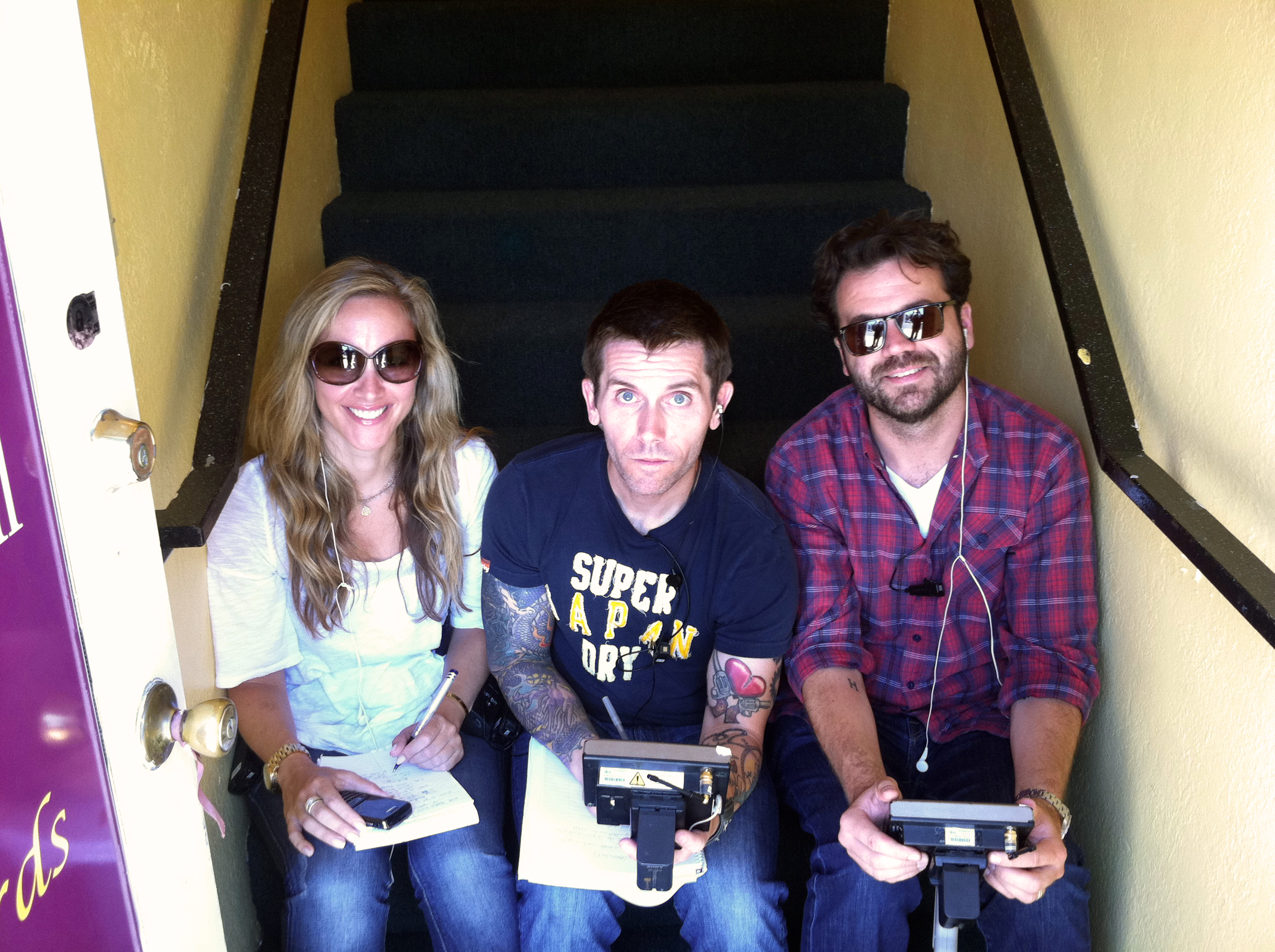
Lauren, Frank, Rob with monitors and notes.

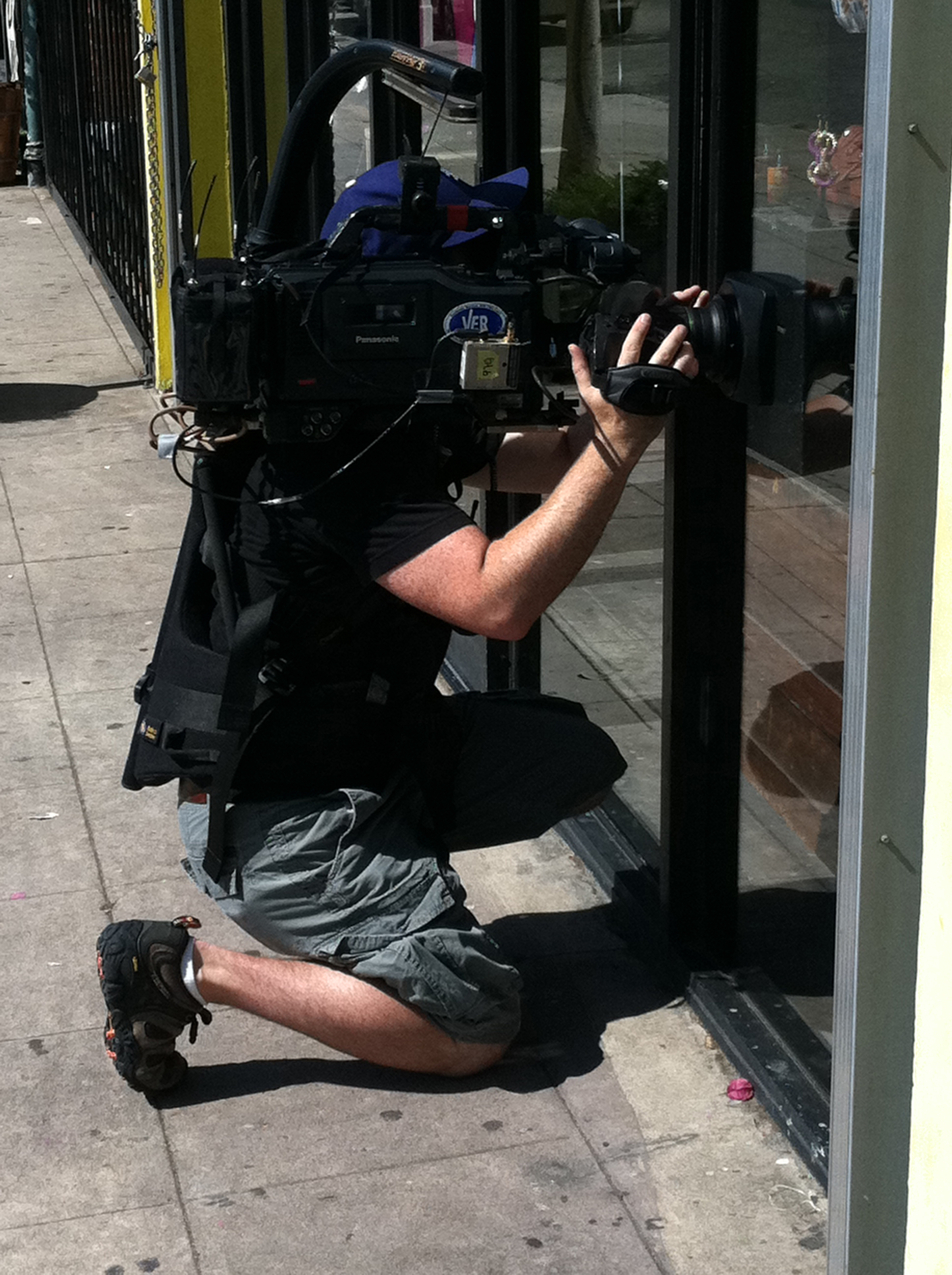
In that extra week I was able to be on set for pilot, driving around LA to different locations, and had a chance to learn the job of a story producer with the story producer that I had worked with on the previous project. The whole day Lauren provided asides as to how things normally work on a production from her experience and examples of how they’ve worked differently as well. She provided a comparison to the last production we had worked on, filling me in on what happened once my work on that pilot had ended and the cross-country shoot began. I found her notes to me really helpful, in that as she would make these comments and I’d take notes that I could see things happening right in front of me opposed to reading or hearing about them and trying to undertand. Though I found some things to be similar to my experience in school and on shoots, there were logistics that I could run by Lauren and get a direct answer which with I was not familiar.

Lauren, Frank and Rob watching cameras live in the location.
Brad, DP getting B-roll.

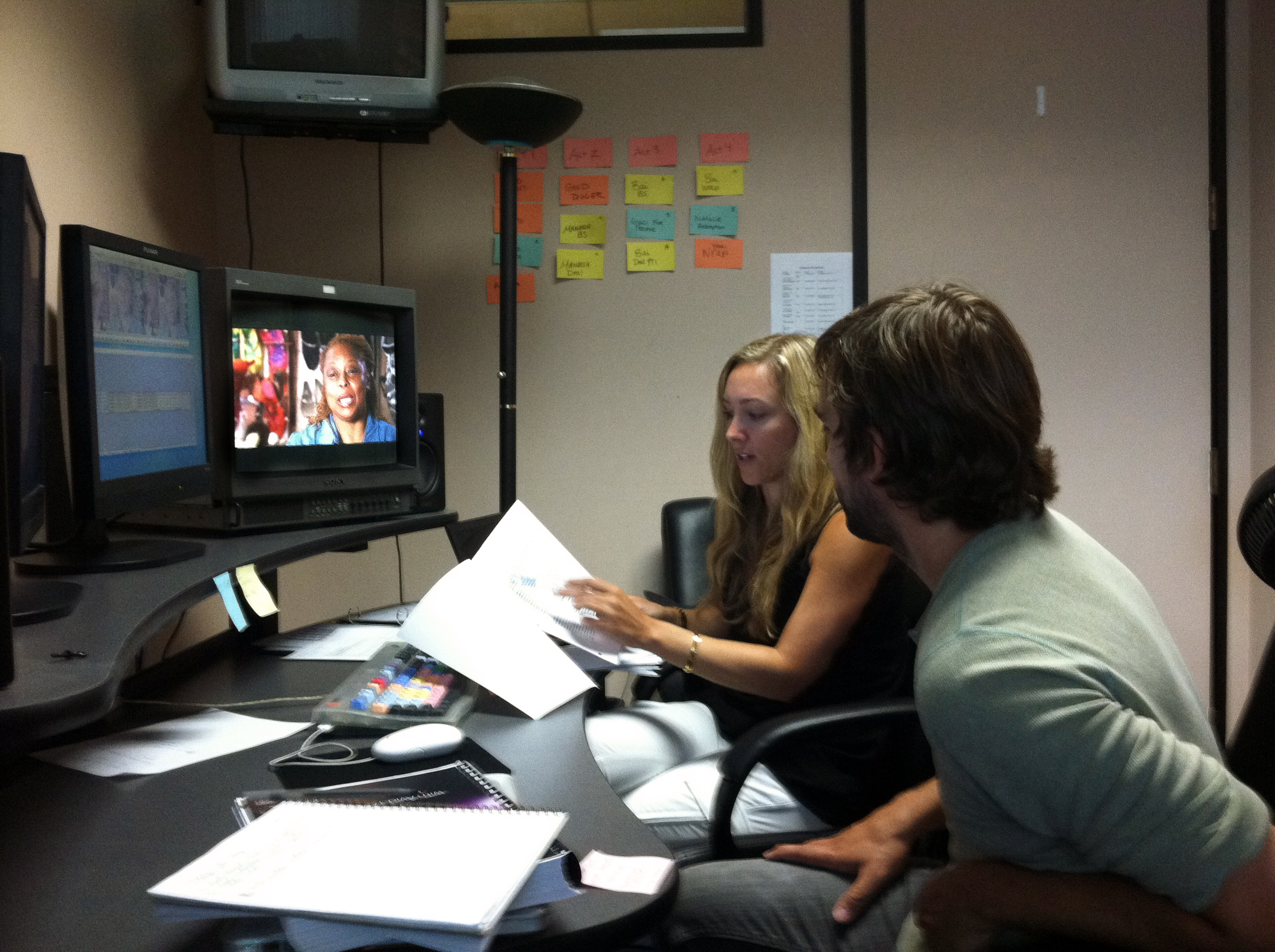
After a day of shooting, I found myself back at the DGA with Lauren to continue the work of the story producer. In the Asylum offices, I was able to sit down with Lauren and go over the footage that was uploaded to their Avid system. I had learned Avid with in grad school with the amazing Neal Coffey and prior had cut 16mm films in undergrad in VPA, Syracuse University’s art school. However seeing an Avid system, and touching for the second time in my life, was a little different. I didn’t understand exactly how the footage was logged and organized but figured it out. I had also never worked with grouped footage and almost wet my pants when I discovered the F5 key’s function, it switches between cameras in the viewer. Lauren saw geeky Avid and showed me how she uses the program to go through footage and create strings, good bits of footage that tell the story. As I sat with Lauren for the next few days, I watched as she juggled the incoming daily footage with her notes as well as the outline of how she and Rob had dived the it into acts. I picked up some slang and was able to put my two cents in and really understand the saying, “That is so good… but it isn’t this show.” When Lauren had strung something together with a good vibe she would know exactly what was missing and, because the production was on going, was able to contact Frank and Rob to tell them what audio bytes she really needed for the story to be most effective and make sense. I found Lauren’s focus to be impressive, reminding me of Lucy on the assembly line of that famous episode of “I Love Lucy.” I started to get it and she let me give it a go with some footage as well.

Lauren going over her strings with Brad, the editor.

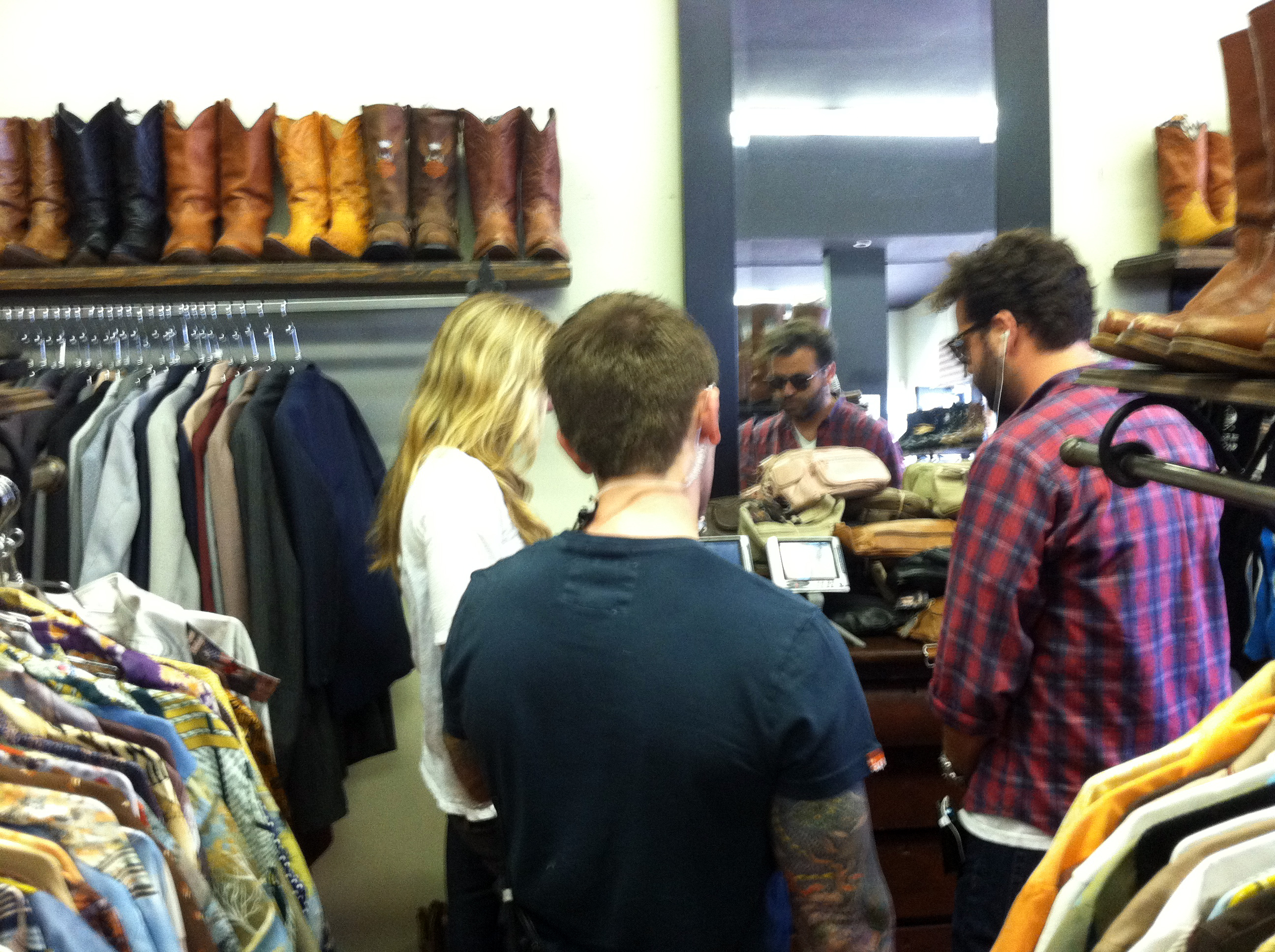
After a few sessions learning from the story producer, I was back on set Saturday for a thirteen hour shoot day. This time on location, Rob had me on both a walkie and listening in on the wireless audio while I watched the monitor. I got to see Rob, the executive producer, in action again and I took furious notes for Lauren from the set. I got to experience the moment when you know you got it and what you just witnessed on the monitor is exactly what your show is about. I got to chat with the crew on set and during lunch, finding that the production manager is from Philly like me and hearing stories from the field.

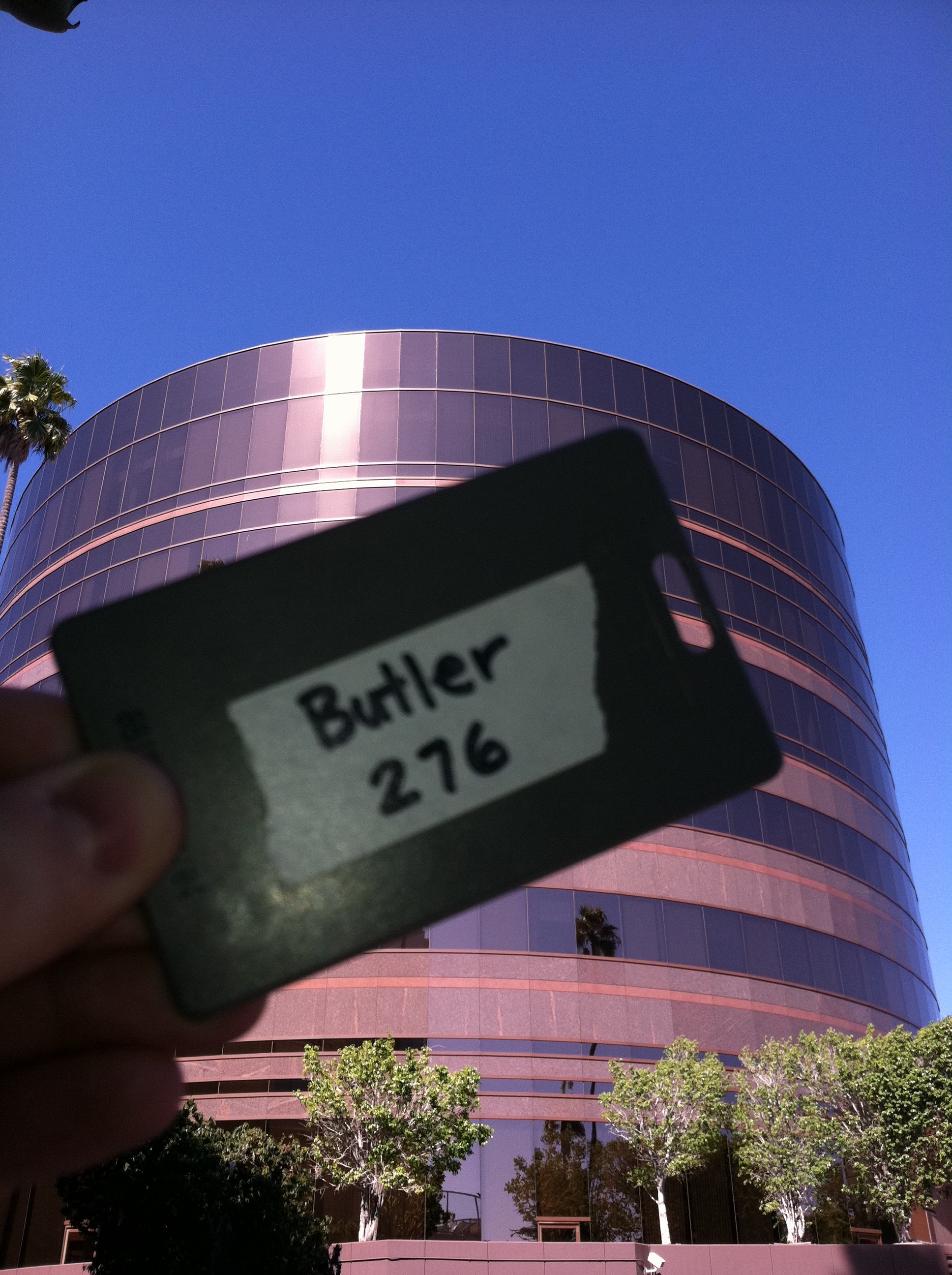
My very own DGA parking pass!

Sitting in for the subject on set.

In the end, I came away with a pretty good understanding of what it takes to make a reality/docu-drama program, the players involved, and came away with a nice little cut I didn’t notice until someone pointed out that I was bleeding. I mean, what’s a day’s work without a little blood?

Now onto the real world… Wish me luck!

Random Thoughts on New York

Posted: 15th August 2011 by lacymitchell in Random Reflections

As my internship is coming to the end, I thought that I
would share some of my Random Thoughts or Lessons from my time in NY.


Warning: The Pigeons are crazy. They are not like normal
birds. They really think they run the city.

When walking in New York, I suggest wearing headphones and
sunglasses at all times Personally, I think sunglasses are a great accessory,
but if they are not for you at least have on the headphones.

Always keep walking. You won’t believe how many people will
try and stop you for something.

Avoid Time Square if you can. It’s like madhouse and if you
are trying to get somewhere you will get frustrated.

No one in NY believes in separate checks or free refills.

New York what is with all the revolving doors? Have you not
seen The Godfather, when Michael Corleone settled all family business?

If you will be in NY for a long length of time get the
unlimited Metro Card.

Avoid the R Train on the weekends if you can. For some
reason that train is always under construction and then you have to try to
figure out where to transfer to get where you planned to go.

Try and visit the Museum of Moving Image. It is a great time
and they currently have a Jim Henson exhibit and it will take you on journey
down memory lane.

My favorite thing has been Rush tickets for Broadway show. I
saw How to Succeed in Business Without Trying for $30 (which was a fabulous
show, I was so close to Daniel Radcliffe that I could see him spit as he sang)
and Spider Man for $40 (the music and the set were amazing, but the story and
acting were not very good, but it was only $40 so I don’t feel bad).

MTA trip planner is better at giving directions than Google
and HopStop (Thanks for the tip Lucy Place).

When walking on the sidewalk try not to walk so close to the
buildings. For some reason there is liquid always dropping from the buildings?
I think it is water from the air conditioners (at least I hope that is what
that is).

So those are some of my random thoughts from my time here in New York.

NPower Overview

Posted: 15th August 2011 by lacymitchell in Random Reflections

As an intern in the market and media research department, I
have my very own Nielsen account. Which I find to be exciting, since my only
exposure to Nielsen numbers were textbooks, various websites and the Station
Index books from the reading room. Nielsen offers a very special service called
Nielsen U. Basically, its instructions and/or overviews of Nielsen and their
various products/software.  I know in
many of the media research positions I’ve seen they will mention to be familiar
with several Nielsen products. Since I have access to Nielsen U, I thought I
would share an overview of some of the software/products. Today, I’ll start
with NPower.

NPower: Report Overview

What is NPower?

Custom Analysis tool

Unparallel ability to focus on
detail

Limitless analysis opportunities

Respondent level data

Report Types

Rating Analysis: 2 types of analysis program and time period

Program Analysis is used: 1. for individual
ratings based on program data 2. Only  report
that generates C3 ratings

Time Period Analysis produces
ratings report based on time period data

Universe Estimate-Provides sample size and weighted universe
estimates

Use to answer: What is the sample size for a particular demo and/or market break
for a specific measurement interval?

Co-Viewing Program-Examine pairs of viewers who watched the same
program on the same TV at the same time.

Use to answer: What program would
best reach children watching with adults, so the primary viewer and primary
consumer are reached together

Length of Tune& Length of View

Length of Tune Time Period-Produces
averages and distributions for tuning events of varying lengths by viewing
source

Length of View Program-Produces
averages and distributions for viewing events of various lengths to a program

Use to answer: How long do viewers
stay tuned into a specific program or daypart

Source & Destination-Produces source and destination ratings
and/or distributions based on selected programs or time periods.

Use to answer: Where did your viewers come from before viewing a particular
program or network and where did they go after?

Reach & Frequency-1.Provides unduplicated audience estimates
and frequency of viewing for schedule for various market breaks and
demographics. 2. Analyzes the
viewing of schedule pairs and determines the exclusivity and duplication
between the two, as well as their individual reach.

Use to answer: 1.What is the reach of an advertising campaign? 2. How many unique people saw a
particular program in a month ?3. How
many people saw the promos for a particular program, and also watched that
program?

Segmentation-1.Produces reports that rank and classify viewers of
selected programs or time periods. 2. Organized
viewers into various segments based on duration of viewing. 3. Can be further analyzed in other
reports.

Use to answer: 1.Who are my loyal viewers? 2.
Who are my heavy, medium, and light viewers? 3. What else do my local, or occasional, or non-viewers watch?

Power Play-1.Desktop research tool used to analyze large data sets.
2. Interactive pivot table that
allows you to change layouts, apply filters and create instant averages

Use to answer: What is the season
to date ratings for all programs airing on a broadcast network?


“Being confused is not always a bad thing”. I will  never forget these words from an ex-employer who was counseling me through my dilemma in choosing the right profession back when I was still an undergrad student. 5 years later, I think he was telling me what I would eventually come to realize on my own. You know that one question your elders ask you when you are growing up, “what do you want to become?”. Of all the trick questions, math problems, angry questions and million other types of questions, THIS was the one I most dreaded. I’d turn pale and speechless, while a family friend peered through his glasses judging every molecule of my existence as if that answer proved whether I was a bright kid or not. But the truth is I simply never bothered deciding upon ONE career path. Which is a problem if you are from a humble, middle-class family like mine from India because there are mostly two or three options you are expected to pursue in order to have a stable and well rewarding career; a doctor, an engineer, a business school graduate or if your family didn’t cringe too much at the sound of this, maybe a professor.

However, there was one single medium that influenced me over and above everything else and decided the course I was to take in my adult life professionally. It was the television. Growing up in the 80s in India, with a single national network, my world was expanding even as I sat within the four walls of my home. Cable was yet to be affordable, so we watched (mostly Sunday mornings through evening because television was strictly a limited entertainment for young kids) BBC dramatic series, cartoons from Europe, old westerns from Hollywood, documentaries from across the globe and of course Indian cinema, mostly the neo-classical arty ones, not your regular Bollywood numbers, some of my Newhouse friends often asked me about. Needless to say all that visual content was enthralling especially if it’s your most awaited release into the surreal world of make believe in an otherwise boring little city. I think I realized eventually through my fantasy of first wanting to be a narrator of wild life documentaries (heavy dosage of Nat Geo and Gerald Durrell books were to blame) and then a travel journalist, that all I wanted to do all my life was to tell stories to people from around the globe, but do so on a more visual level. It’s true just as one of the topics here on 4th Wall reads : A picture’s worth a thousand words, and video is worth a million!”

That epiphany led me to start out at as a Broadcast reporter in India and then when I realized I wanted to script and present longer format, an Associate producer for a TV series. Two and a half years into my television career, I was still craving for more visual and narrative freedom. And so I made the decision to quit my job and pursue a Master’s in the US to give me some time, sort of a sabbatical to understand what aspect of story-telling in the media I wanted to invest myself in. To be very honest, Newhouse was almost accidental. I had made up my mind that I would pursue higher education in either cinematography or filmmaking. But amongst my numerous applications to universities and conversations with Indian students abroad, Newhouse gained more points over any film school. Most people who had graduated from the TRF course, spoke of having a unique vantage view of the industry, an insight into how the creative, business, the legal and technical of the media were enmeshed. A week after I changed my mind from wanting a pure aesthetic and technical training in filmmaking and instead take up a course that would help me understand the business side of the industry as well, I got a mail from Professor Schoonmaker offering me an IA’s position and a fantastic scholarship. By then I had spoken to at least 4 Newhouse alums and a faculty to know this course was going to give me a chance to dabble in a bit of everything. And going by how I never wanted one defining career path so that I could have a diverse and richer learning experience from my professional escapades, I realized Newhouse made more sense. I accepted the position and got a mail from Professor Schoonmaker that simply read “YAAAAAAAAAAAY! We will have a fantastic team with you on board”. I instantly knew I was headed the right place 🙂

A year later, I think he couldn’t have been more right. TRF turned out to be a great team experience more than being a whirlwind of an academic experience. I not only got to pursue writing, film production and lighting but also got a peek into the world of the business of “show business”. Somewhere within, I realized I wanted to marry the creative side of my personality to the more strategic. I know I love stories and I want to take more unique, fresher films to a wider audience. Shouldn’t I be looking at becoming a “Development Executive” or what in India we often dub as “Creative Producers”? After my first Newhouse “Industry Trip” to LA with Schoony and Tom Seely, I came back thinking more about the conversations I had with business executives and producers I met on the trip. After weeks of searching for an internship that would allow me to learn more about development while also getting to observe what producers do in Hollywood, I landed an internship with Mandalay Pictures. The company started by Peter Guber (also an Orange-man) is presently in active development mode with its “first-look deal” arrangement with Universal. Added to that, the internship promised no running errands or carrying coffee but an opportunity to spend as much time as possible learning any aspect of the industry that Mandalay specialized in namely development, production and financing. I couldn’t be happier! Two months have passed by and I am done with my internship and more clear than ever what I want to specialize in as I go ahead. As Peter Guber says “it’s not just show-show but show business” and as much as I earlier stayed away from this side of the motion picture industry, given how money translates today from Indian conglomerates to Hollywood studios, I know that I want to be in a position a few years from now where I can help bring in financing for the stories that don’t get to be made or help distribute the films that people don’t get to watch. I am international student and so the job hunting process is going to be even tougher but armed with more practical knowledge than I had before and a sound internship with some good contacts that have followed, I hope the job hunting process will be exciting albeit daunting. Thank you Newhouse and thank you TRF 63. The journey’s just begun.