So I’ve been reading some of the other posts from “Notes From the 4th Wall” particularly this one, from Eric Lee. Writers always write! He says! Keep training, always, even if you don’t have work! That’s how you’ll get good enough to get work!

It’s great advice for people of any profession- editors included. My roommate Alex has been in touch with editors from TheAntFarm– a post-production house with their hands in a lot of different pies, from video games to movie trailers. Their advice? Keep editing, even if you don’t have work. Want to work for a trailer house? Recut old movies and make trailers- show them you know how to do it! Want to work on music videos? Just go do it!

The example they provided – this montage of a bunch of films from 2011- was done well enough to get the creator a lot of views, and eventually get him hired!

[youtube=http://www.youtube.com/watch?v=I4dEWOB6THE]

“Just go do it” sounds like stupid advice, but trust me, once you hit unemployment- it gets tough to get up and do anything. It’s all too easy to get up at the crack of 2PM, watch netflix, and do nothing when you don’t have a job. Especially when you live in LA where different weather conditions don’t exist- everyday looks exactly the same. The worst day of unemployment I ever had. I thought it was a Tuesday, so I figured I’d watch some TV before I did a little job searching. It was Friday.

Things can get away from you if you’re not careful, so make sure you use your time wisely! Unemployment does not mean ‘do nothing’ whether it’s working on recreational projects or looking for jobs, there’s always something you can do to stay sharp and not watch TV for three days without moving (wait, that’s just me). So keep at it!  

Networking

Posted: 24th September 2011 by bgay0315 in Notes to Sequence 64

I remembered an interesting conversation I had with some of the people at work about resumes and cover letters, and so forth- it’s who you know, not what you know.

Case in point one of my coworkers had heard through the grapevine that Nickelodeon was hiring, but when she checked the website? Nothing there, even though she knew for a fact positions were open.

Also? A second co-workers said she had heard that Dreamworks won’t even put up PA listings online because they don’t want their website flooded with all thsoe eagers college grads begging to go get coffee.  So even IF the jobs are there, they aren’t always going to be listed.

Finally, my supervisor told me how he got his first job: he was a PA on a reality show, the producer liked him, and got him a job as a Post-production PA on his next gig, no questions asked. He told me that if he got another job and they asked him who he knew and trusted, if he named me? Hired no question.

So it’s who you know, not what you know! So go forth and network! Or else!

It’s a tough job to watch all the crap the network puts out, but somebody has to do it. And by ‘somebody’, I typically mean the intern. A pretty huge part of my job was logging footage for these old kung-fu movies the network airs. About 98% they’re terrible- they make no sense, they’re dubbed over in English terribly (often by non-English speakers, if that makes any sense), and they’re at least an hour and a half, without question. But they have to be watched- every minute, every second. Because as the post-intern, it’s my job to look for breaks in the movie to put in handy commercials. And I have to find every single line of profanity in the movie to bleep it out- which basically means I now have to watch some of these terrible moviestwice– once to find everything, and a second time to check my work. It gets miserable sometimes.

Sometimes though, you find movies that are so terrible it’s hilarious. Here’s the end of one of the movies I had to watch- “The Ninja Squad”.  I’ll let the clip speak for itself.

[youtube=http://www.youtube.com/watch?v=-f-1-YVBuXE]

Clearly all kinds of things went wrong with this movie- there’s white people ninjas everywhere in China (totally normal). There’s this wacky 80s music playing at all times. The costumes are shoddy, with headbands that HAVE THE WORD ‘NINJA ON THEM. They’re filming in random locations (usually a public park or a rock quary) with no permit. All of the music is justblatantly stolen from other movies or tv shows,  because Hong Kong didn’t care at all about copyright in the 80s.  Half of these director’s films aren’t even real ‘films’- he’s cut together multiple movies and dubbed over the dialouge to make completely different plots. Also, I did some digging, and it looks like half of the actors were strong-armed into doing the films against their will for NO MONEY by the Triads. It’s literally absolutely INCREDIBLE that so many things went this wrong in some of these movies.

I’m literally just speechless some days.

So yeah, this is what I do, for like 15 hours a week. And I’d call this one of the better films I had to watch.

Good times.

Endurance

Posted: 24th September 2011 by bgay0315 in Notes to Sequence 64, Random Reflections

Sometimes editing can be fun and exciting work. Other times, it’s boring and tedious to the point of total misery. That’s why I’d probably say endurance is the most important trait to have in terms of being an editor. Technical ability is important I would say, but the endurance to last through both tedium and calamity are what separate editors from the rest.

An example: The other day, my computer just randomly stopped capturing footage in Final Cut Pro. I checked all the wires and connections no idea what had happened. Restarted the computer six or seven times. No luck. Checked with my supervisor. Also no idea. Called over the IT guy. He shrugged his shoulders. Told me he’d order some parts and fix it eventually. Normally that’s pretty much the ‘pack it up and go home’ moment, but I decided to keep searching for a solution. After an hour of crawling through IT forums with no luck, I eventually started to home in on a solution. Something was wrong with the firewire driver for the Mac and I needed to get settings to reset. Eventually I attempt to reset the system management controller (no idea what it meant, but hell, worth a shot) and voila! The modest intern succeeds at fixing a problem his 10-years-of-experience boss and know-it-all IT guy could not!

Endurance beats raw talent every time, folks. Never say die, keep at it, don’t hesitate to put in the work, and you’ll be fine.

One of the things I had really big questions about when I came out was the Editor’s Reel. Obviously I knew it would be a little different than a Director’s/Cinematographer’s Reel for a couple of reasons- first, a quick montage doesn’t really always show that you know what you’re doing in terms of pacing, story, etc. And second, quite simply, is that a lot of your best work as an editor is going to involve salvaging garbage-footage until it’s somewhere between good and mediocre. That’s something that’s hard to convey (though a friend of mine uses wipe transitions to excellent effect to show off his coloring skills here).

So I asked my boss at my internship what he thought- he replied that it probably didn’t matter anyway, honestly since most of your jobs were going to come from someone you knew vouching for you.

But you’re going to have do one eventually, so I pressed him on it. His advice was short clips of your work, captions showing the title and what you did on it, and to keep it between 3-5 minutes.

Which sounds fine. But keep in mind that production-types are going to be watching your reel and hiring, not other editors. And in my experience internship-wise, production types don’t have a very long attention span.

So this is my advice: You need to make an impression in about 30 seconds.  Your best work obviously has to be up front. And I’d try to keep the whole thing at or around 2 minutes, not 3-5. Trust me, a producer/hiring guy isn’t going to watch much more than that. My supervisor’s bosses would shred his work  sometimes after the first 20 seconds. Then they’d nitpick about things for so long they’d forget to watch the rest.

Bottom line: you don’t have a lot of time to make an impression, so move fast and make it count.

With that in mind: Here’s the prototype reel I came up with for now:

[youtube=http://www.youtube.com/watch?v=BcqNk6VvfmU]

Good luck with your own, and happy editing!

Advice

Posted: 24th September 2011 by bgay0315 in Notes to Sequence 64

So on my way out the door on my internship, graphics guy attempted to drop some knowledge on me. He told me: “A word of advice: Be the positive guy at your job! Nobody likes the cynical guy who says things can’t be done!”

I don’t recommend adhering to this if you’re trying to survive in post-production.

There’s nothing wrong with a “Make it Work” attitude, but at the same time, you need to know your limits. Is the audio for whatever you’re working on so bad the project’s unsalvageable? then you need to tell someone now, before you spend two days working on it only for your boss to walk by and say “Holy christ, that sounds terrible! Throw it away, we need to reshoot!” Some things can be fixed, some things can’t, but the trick is knowing when “fixing it” is worth it versus when fixing it costs more time/money than just flat out starting over.

So here’s my better advice: Don’t hesitate to tell someone there’s a problem.

You can beat your head against the wall all you want looking for a magic solution in Final Cut, but often it’s faster and MUCH less painful to just have a conversation about it and see if you can’t fix it in pre-production (or nix the idea completely).

I know no one wants to look incompetent by bringing up the problem, but trust me, you’re going to look way worse if you can’t fix it and people are screwed because nobody ever brought it up. You’d think grown ups with jobs would be past this but trust me, they aren’t. Communication is your greatest weapon in post- don’t forget that!

Internship notes: Archiving

Posted: 24th September 2011 by bgay0315 in Random Reflections

So I’ve started at Blackbelt, as a post intern- they’ve got me doing a few different things- logging footage, taking notes, etc. First thing I notice? In a small operation like this, it’s the little things that can kill you.

My boss tells me to pull some files off the network server so I can watch them and take notes, right? But the files are all huge and completely uncompressed, and the network is jammed up because it’s the middle of the afternoon and everyone is using it- ETA, 4 hours. I only work 8 hours a day- you can’t have employees who can’t work 50% of the time.

My boss told me another story that same day- the producer for the network wanted 24 hours of content on DVD. Which meant pulling 24 hours of uncompressed footage off the network servers (which took a full weekend), and compressing all of it down, which took even more time. The network suit wanted this done in like an afternoon. It took a week.

You wouldn’t think that a footage archivist would be that important on a television network, but after a day I could tell they needed one bad- without one we’re losing huge chunks of time to minor assignments. If we had a few more editors, I would say that every week, somebody probably needs to compress everything we do into a smaller format we can get at quicker, and probably burn that to a DVD while we’re at it so we can access it quickly.

But we’re completely understaffed (there’s one employed editor), so there’s not a lot we can do.

There’s a lot of ways to cut costs, and everyone likes to just tell people to suck it up and multitask. But if you aren’t willing to pay people to do what needs to be done, there’s going to be problems- and this was one.

PA Experience Part 3 – The Voice

Posted: 21st September 2011 by Adrienne in Random Reflections

A few weeks ago I got a weeks worth of work as a PA doing LA auditions for The Voice. I had a friend who was working as a casting associate for the show and had traveled all over the country, spending a week in major cities around the US working auditions. LA was the last stop for auditions, and my friend got me a job working auditions for LA. The week progressed as follows: Monday was set up, Tuesday and Wednesday were open auditions, Thursday and Friday were appointments, and Saturday and Sunday were call backs for people from open auditions. About 15 PAs, myself included, were brought in on Monday for set up. A majority of these PAs had done other cities (they paid for their travel and hotels, and then were paid less than $150 a day, so, in the end they were losing money, why they would do this, I don’t know). When I first got the call for the job I was told I would be working Tuesday and Wednesday and then maybe more days, but the PAs traveling from out of the area would get priority to work for the rest of the week. On Sunday before the week started we got an email saying we would be getting a call sheet soon, and that about 15 of us would be called if we were going to be brought in to work Monday. I was one of the PAs who got to work Monday.

Monday: Right from the start I made sure I was constantly working, I was up against the out of town PAs for more work and I needed to stand out. Set up involved setting up the production office, setting up 14 audition rooms, setting up the holding lines outside, and setting up the holding lines and check in tables inside. The majority of PA work involves very little brain power, so I am always looking for ways to show that I am not an idiot. I got to do this when some of the other PAs were struggling to hang up a banner. I helped work out a zip tie system and made a “rope” out of gaff tape to help get the banner up. So it is just little things like these that make you stand out as a hard worker and a problem solver. I made friends with a few of the other PAs who had done other cities, and got the break down on how the next two days would work, so I was prepared for what was ahead. Set up was about a 7 hour day, nothing too bad.

Tuesday and Wednesday: For these two days we had about 65 PAs (that is a lot of PAs to stand out against). We were assigned teams, each team had a different task. I was on the blue team, and it was our job to get people checked in, and to make sure that the 9 check in lines were even. Blue teams call time was 5am, so I was up at 3:45am to get to work on time. All my fellow blue team members positioned themselves at the check in table, where their job was to either check paperwork and IDs, or scan people’s passes before they were put into holding. I offered to take on the job of putting people in 1 of the 9 check in lines. So I was placed between security check in and the check in lines, before the first day of auditions started I wondered how I was going to handle putting every single one of the 1000’s of people auditioning into a line by myself, without things getting totally unorganized. Luckily the security check point kept the number of people coming to me under control, and at most I only had to direct up to 10 confused and excited contestants into a check in line at a time. The most annoying part of my job was that before I could send someone into a line I had to ask them if they needed to go to the bathroom before they got in line because we didn’t want them getting out of line. Some took me asking as me telling them they HAD to go to the bathroom before they got in line. One contestant told me that was a weird question and that he had never been asked it before, he also asked if he could just do some wandering because he had never been to the venue before. I told him we have a strict system and there is no wondering allowed. I was offered relief from this position from time to time by my fellow blue team members, but I liked being active and on my feet way more than sitting at a table checking ID’s so I always turned down any offers for someone to replace me. So for both days of open auditions I stood at the front of the check in lines and asked people if they had to go to the bathroom before they got in line. So far none of this really felt like PA work, more like herding cattle, but I was still having a good time.

Thursday and Friday: At the end of the day on Wednesday the blue team was pulled aside by one of the coordinators, he told us that we were the best blue team he had had in any city, and that because we did such a good job, we made everyone else’s jobs easier, go blue team. He also asked us what our availability was for the rest of the week, and again said the non-local PAs would have priority because they had come out to LA just to work on the show, and that also anyone who was available all four of the remaining audition days would get priority because that way he wouldn’t have to constantly explain how things worked to new people everyday. I was available all 4 days, so I was hoping this in combination with how hard I had been working would get me a few more days of work. So I went home and waited for a call Wednesday night, I even turned down a day of work on Thursday since I had already said I was available to work for The Voice. It started to get a little late and I hadn’t gotten a call yet, and I was getting down on myself for turning down the other job, but then I finally got the call, I was going to get two more days of work. For open auditions we were at The Forum in Inglewood, one of the auditions rooms was literally the lakers old locker room. But now for auditions by appointment we were at a new location. With appointments we saw way less people, and had a whole different system. On Thursday I was positioned outside of an interview room with another PA, my new friend Frances. Each person auditioning had an envelope with their information and some other stuff in it, but they weren’t allowed to ever hold their own envelopes. So my dear friend Frances stayed outside of the interview room and held envelopes for about 3 or 4 people as they waited to go into interview. It was my job to go pick up people as they came out of one of the audition rooms, and bring them to our interview room, I then had to escort them back to the holding area where they had checked in, so they could check out. All this escorting was necessary because the contestants had to stay with their envelope, but again, could not hold their own envelopes. Thursday was a lot of fun, Frances, a mother of 2, who had served in the army and then became a nurse, was a blast, she had me laughing all day. Frances and I met some exciting people while working together. We met the guy who was Zac Efrons singing voice in the first  High School Musical, and one of the guys auditioning had the guitarist from Lifehouse as his accompaniment. Frances had not heard of Lifehouse, so when she pulled out her phone to look them up the first google hit she got was for life-goose. So all the guys waiting to get into interview started joking with Frances, and started calling her mother goose. Another random thing that was going on was Joe Jonas was rehearsing for a tour or something in the same building where we were holding interviews. They kept leaving the doors open to his sound studio, so Frances or I kept going over and closing the doors to their sound studio. We got some dirty looks from Joe Jonas, but, he was being disruptive to our audition folk. Friday was a little hectic, one of the audition rooms and my interview room were right next to each other, and each room had 2 PAs, one stationary PA and a runner, who brought people to each room. On Friday one of the audition rooms lost their stationary PA to another room, and then they took my Frances from me and put her inside the audition room to help out in there. So me and the runner for one of the audition rooms took matters into our own hands. I became the runner for both rooms, while she became the stationary PA for both rooms. So she held the envelops of people waiting to go inside either room, and I took people to and from the rooms. I must have walked a several miles that day escorting people, but I had a good time, and liked staying active.

Sunday: In the middle of the day on Thursday I was offered more work over the weekend, but I had to have Saturday off, because if you work 6 days in a row on the 6th day you get time and half and they didn’t want to pay anyone any more than they had to. I went into work on Sunday, and me and the other PA who had done one of the audition rooms and an interview room on Friday were all set to have those two rooms running smoothly. We positioned ourselves outside the rooms, waiting for the last day of auditions to start. Then I got a call over my walkie from one of the coordinators asking where I was, before I even had a chance to answer he showed up outside of my interview room. He came over to me and said “you know cameras right?” I said I did, and he then told me I was going to be on camera in one of the audition room. I know I instantly turned bright red, I was excited to get to do camera, but I didn’t want to mess anything up. So I went into the audition room and the guy who decides whether or not the singers move on gave me the run down of what they wanted. Get a close up of the persons envelope which had their name written on it, then set the aperture and focus, and then get close ups during the verses, slow zoom out at the chorus, and then a slow zoom back in. No problem, this was gonna be easy, but I was so scared to mess something up that for the first 3 or so people auditioning my hand was shaking and my slow zooms were a little rough. I quickly got comfortable and started to get the hang of it.  Everything was going well, but then every once in a while the guy who chose who moved on would come up behind me all excited, dancing and shouting “whoo” and he would come and look at my shot and be like “yeah yeah, zoom out, good, good, this guys gonna be on the show, this guys gonna be on the show!” And every time he came up behind me I would get nervous again and my hand would start shaking and my zooms would go to shit. At the end of the day I did have a good time though, although I  can no longer listen to Adele’s Rolling in the Deep or Someone Like You or Foster the People’s Pumped Up Kicks, because way too many people sang those songs for their audition. When we were all done all the important people came out of their audition or interview rooms and started popping bottles of champagne. Auditions were over, so we drank champagne and then packed everything up.

Working in The Voice was some of the most fun I’ve had working so far, it was exhausting and I worked my ass off, but I met some great PAs who I still stay in touch with (Frances and I text all the time). What I’ve taken out of this experience is that your friends help you get jobs, but you’ve got to work hard to stay on the job. Almost all of the work I have gotten has been through friends, but I think its how hard you work once you get the job that is what really gets people to keep hiring you. I am so grateful to all of my friends who have helped me get work, and I have even gotten to a point where I am helping some of my friends get work. Also, I couldn’t have been more thrilled to be chosen from a group of 65 PAs to get more work for the week, so keep your friends close to help you get work, but then work your ass off to keep yourself working.
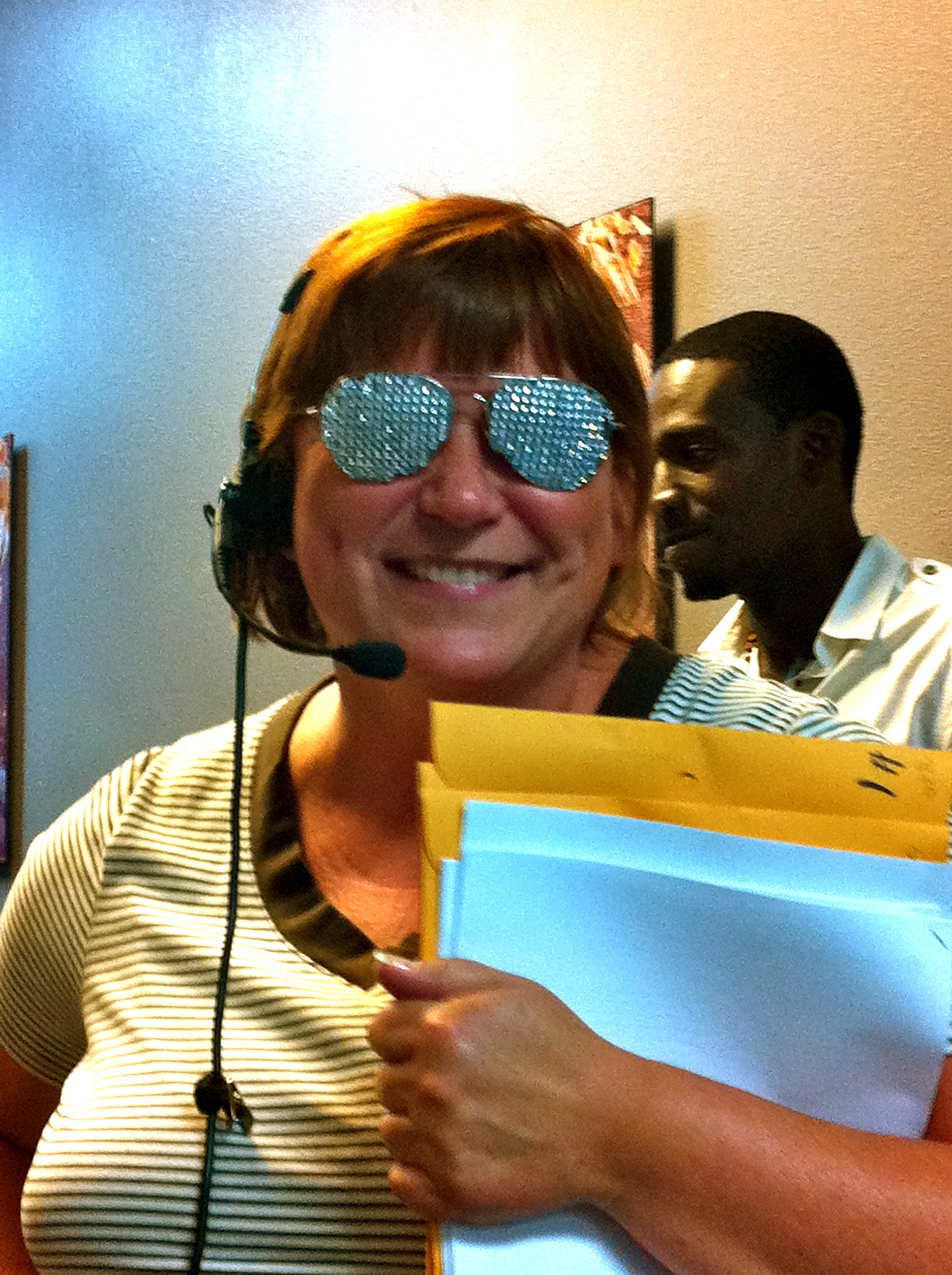
My home girl Frances wearing one of the contestants glasses.I told her she looked fly, she thought I said she looked like a fly, oh Frances.

My itineraries @ HSN—Guest training

Posted: 20th September 2011 by momentlu in Random Reflections

August 1, 2011 //

Edit this entry

As I mentioned earlier, another main job for the off-line shows is the guest training. So what is guest training? Okay, if you watched HSN shows before, you probably noticed that a great portion of the shows are not only presented by a host but also by a guest, who is normally the product representative. Because they apparently know the product better than the host; and since HSN has a special part in each live show, the costumer call, the guest plays an important role to answer the costumers’ questions live.
I didn’t know before I had this internship, that it is actually very difficult to be a host at a shopping channel, that’s why they need tons of training. Because there is so much instant information to pass along to the audience from the producer without showing that you are simply copying the words from the producer; and also the host needs smart instant reactions to cover the issues only happens in live shows. Besides, it is never an easy job to fill 30-minute or even an hour presenting just one product without a script. I mean, what else you can say? Okay, my point is, if the host needs training, the guest needs training even more. And that’s the job of off-line team. Their main goal is to make sure that the guest gets used to the camera. What I do is to work with the off-line director and deal with the switcher and count down like a real live show so that the guest will get better and better by this kind of training. In the end, they will overcome all the problems, like talking to the camera 1 when the director’s cut to the camera 2 already or rolling their eyes in front of the camera ( because they keep checking what they look like in the monitor.)

What I want to say is that I really enjoyed this internship at HSN. People here are really willing to teach you things, and you will be treated seriously. I learned a lot here and if you are interested in live TV shows or you like to work in the control room, or you like shopping (did I mention that you’ll get great discount here?), HSN is really a good place to get some experience.

Categories Uncategorized

In the next two weeks, I worked with the off-line team. And my job is to be the TD while taping. Because it is not live, less people work on it compared to the live shows. There are no graphics and audio people during the off-line taping. Only one director in the control room and maybe two camera people; however, still we need to pay a lot of attention to the details. One thing I forgot to mention is that here at HSN the cameras are all computer controlled like a robot except one camera on the stage that is called Jib. Jib is specially for the high angle shots.

Okay, about the off-line tape. What we do are basically two things; one is to tape the video packages for the live shows. These videos will be played during the live shows for different purpose, and some of them have crazy names or I should say they are just terms at HSN, such as showstoppers, quick-buy or great-buy. Showstoppers are like mini promos for the products, and they give the host time, normally 30 seconds, to transfer from one studio to another. For instance, if the first show is about cosmetics and the next one is a cook show, this 30-second would be very important for the host to relocate. And interestingly, sometimes the crew takes the host to the next studio by wheel chair in order to save time and avoid the host sweating or panting. Other videos are made for products that need a lot of close-ups, best example would be jewelries. So to make sure the product is perfect to be seen by millions of audience during the air those videos are crucial. Like I said, even though it is not taped live, it is never too careful when it comes to the details. It is very usual that we spend an hour to tape 20-second video. The director will discuss every thing with the vendor who is the representative of the product. Even a tiny reflection on a silver ring can be the reason to reshoot.

Categories Uncategorized

In these two weeks, the best place for me to learn is the Control Room.
There are three control rooms in total at HSN. One for 24 hours live shows and the other two are the back-up ones, primary for the directors or associate directors to check the graphics or videos before air. And also for the off-line people to tape the promos or do the Guest Training, because the main control room is running all day long.
One thing is different here at HSN is that there is no Technical Directors in the control room, which means the directors have to act both the TD and the director.
Okay, during the live shows, the Associate Director plays a role to pre-set the graphics and videos for the director. (Sitting on the left)
For the Graphics person, obviously, he takes charge of the graphics, such as the price of the products, and he sits on the right.
And Producer sits on the second row behind the director, associate director and graphics person. He is the one that talks to the host most frequently feeding them the sale numbers or other information.
Don’t forget the Audio person, who sits in the smaller room next to the control room. He takes charge of the microphones of the host and the guest as well as the music mainly in the beginning and end of each product presentation.

Categories Uncategorized

I started my internship late June at HSN as a director intern and I was told that I’m the first director intern at HSN. So, I guess I’m lucky. :-)
Basically, my job for the first two weeks is to shadow one of the directors whose name is Craig, a super nice gentle director, and to learn how live shows work as a whole. And one of the things I’ve learned during the two weeks is even though it’s only one minute on air it always took the crew hours or even days to get ready. So, below is what a director needs to do before a live show airs at HSN;
First of all, always come to the office two hours earlier. I don’t know if it is the rule for the directors at HSN; however, I always saw the directors come to the office at least two hours earlier. I guess, it’s always good to have more time to prepare.
Second of all, always double check all of the graphics and videos for the show in person in the control room to make sure everything is there.
Next, always check the studio and the set and make sure everything’s right.
Last, have pre-production meeting with producers, associate director and stage manager and make sure everyone’s on the same page.

Categories Uncategorized

I think it is safe to say that just about everyone gets nervous about their first day of work. So what if you had to experience that first day of work more than once a week? If you’re a freelance PA there is a good chance you work for more than one production company in the same week. This week I will be working for 3 different production companies. Steady work comes slow, and the longest I’ve worked for the same production company so far was 6 days (I will blog about this later when I do PA Experience Part 3). So you’re call time is 5am, and you’re losing sleep over the stress of dealing with the dreaded “first day of work,” so how do you make this whole experience easier on yourself? Just as a side note, this advice is geared towards people working as set PAs, not office PAs.

What do you wear? No need to empty out your whole closet and stress out about finding the perfect outfit that will impress your boss/co-workers, as a PA you have the luxury of crew black. All you need is a black shirt of some sort. I enjoy bragging to my friends that have desk jobs that I get to wear a black t-shirt and jeans to work. I typically wear a plain black v-neck t-shirt, people wear shirts with text/logos/pictures etc on them, but for the first day, I just go with a plain shirt to be safe. As for jeans, anything dark or even light is acceptable. I like to wear jeans that have deep pockets because as a PA you usually have to hold onto stuff like petty cash, receipts, maybe some tapes, batteries, keys to a cargo van or cube truck. So deep or big pockets are a plus. A belt is also necessary so I can put my multi-tool and  a walkie on it. It’s not the end of the world if you don’t wear black, but the majority of the crew will be wearing black, and you will stand out less if you just wear black. Just keep in mind that you are likely to be moving around a lot and will also be moving and lifting stuff a lot as well, so you want to be dressed comfortably. As for shoes, just wear some comfortable sneakers that are in decent condition.

How early should you arrive/getting to work on time? I like to sleep in as late as possible, the more I work the less time I give myself  to get ready to leave for work, potentially very risky, but, you will eventually reach a point where you don’t need an excessive amount of time to get ready for that “first day of work.” Thanks to my iphone I can figure out how long it will take me to get to work with traffic. Then to be safe I always add an extra 30-45 minutes, although I am starting to cut down on this cushion of extra time the more I work. The big thing for me with those first days is parking. Sometimes you will be given instructions on where to park, but not all the time. It is safe to assume that if you haven’t been told to park in some lot or parking garage that you might want to give yourself an extra 15 minutes to find parking. Even though you may work a different job every few days, it is not impossible to develop some kind of routine. For me, I get up 30 minutes before I have to leave, I add on an extra 30 minutes to my travel time, eat breakfast in the car, and usually arrive to work plenty early, I then sit in my car until about 15 minutes to my call time, and then off I go. If it appears that finding wherever you have to check in for this “first day of work” is going to be difficult, make sure you give yourself enough time to wander and find where you have to be. Overall, I try to be about 10 minutes early, to accomplish this give yourself more time than you think you need to get where your going, and always factor in the time it may take to find parking, you don’t want to be constantly running off to feed your meter or move your car, so give yourself enough time to find long term parking, even if that means parking a few blocks away. It is also a good idea to have a full tank of gas or close to one, if you are going to be sent out on runs you don’t want to delay your tasks by having to stop for gas.

What to bring to work? For me, I try to keep it simple, no purse or bag for me, so that’s where those big pockets come in handy. Keeping things to a minimum, here is what I always bring to work with me: wallet, phone, multi-tool, box cutter, permanent marker, pen, and piece of paper for taking notes and or making shopping lists or writing down lunch orders.  If you know you’ll be outside, bring sunscreen, a hat is a good idea too, and sunglasses. Typically you don’t have to worry about packing a lunch or snacks, if you’re working on set lunch is generally provided, and there is always crafty, and if you’re lucky, you’ll get second meal (but don’t count on it). Also, if you know that you are going to be working late and it is likely to get cooler in the evening its always safe to have a sweatshirt or a long sleeved something you can throw on.

I think that covers the main 3 things I worry about when prepping for a new day of work. Pretty simple, and in the end, no need to really stress about any of it too much.